
Finding a Hoboken Street Directory Trail
Start with one complete Hoboken address, including the unit when it matters, then preserve the original form before changing abbreviations. Hoboken’s numbered east-west streets, Washington Street spine, and named north-south streets occur in several Hoboken record systems. Older Hoboken material can use a form such as “Newark av.” A current Hoboken parcel can identify a property, a Hoboken deed can identify a recorded party, a voter process can address an authorized individual question, and a directory can place a name at a Hoboken address in a stated year. None of those is a one-click residents-by-street index, and no official Hoboken index of that kind was located.
- Search the Hoboken address in NJ GIS Property Explorer with Hudson County and Hoboken. Save the block, lot, PIN, and any adjoining parcel references.
- Use the Hoboken Tax Assessor and NJACTB path to compare the Hoboken tax-list owner, mailing address, assessment, and tax-map context. Treat a masked result as a cue to retain the parcel identifier.
- Take the Hoboken owner or recorded party name to the Hudson County Register. Search both grantor and grantee roles, then note the instrument date, type, and legal description.
- For a permitted Hoboken individual-status question, use the state voter tool or contact the county election office about a statutory list. A ward or district helps with election geography, not a claim of occupancy.
- Search the Hoboken street and number in digitized or library-held directories. Record the exact year and page, then compare nearby entries, deeds, and maps before drawing a historic conclusion.
That order keeps the Hoboken street directory useful without collapsing different Hoboken records into one answer. It also makes a future counter or request search more precise.
Hoboken Street Forms Before Searching
Keep two versions of a Hoboken address in your notes: the printed form and a modern normalized form. The Hoboken City Hall entry in an 1862–63 directory, for example, uses paired numbers and “Newark av.” That Hoboken typography may be historical, not a different place. Search the number with both “avenue” and “av,” try the street without the unit, and inspect page images around an OCR hit. If a result connects a person to a business and a home address, label the role rather than assuming either address was owned or current.
Hoboken’s grid also changed in extent as the city developed. A Hoboken period map is often needed before a modern street match makes sense. Save a Hoboken cross street where one is available, because it can distinguish two plausible historic spellings.
Hoboken Parcel Keys by Street
For a Hoboken street directory search, the parcel is the bridge between a Hoboken address and Hoboken land records. NJ GIS documents searches by address, county, municipality, block, and lot, and states that its PIN matches the PAMS database. It can establish which Hoboken parcel is being examined and which parcel references adjoin it. The hosted layer is locally stewarded and is not a certified tax map or survey, so use the Hoboken tax map or custodian when a formal map is needed.
NJACTB’s property-search entry was inspected with a CAPTCHA blocking the live RecordSearch form.
The access block means the precise NJACTB field order, parcel-card layout, coverage, and online-copy charges for Hoboken should be confirmed live. The Hoboken assessor’s maintained records remain the documented route for the Hoboken tax map, tax list, ownership, mailing-address, and assessment context.
- Parcel
- A mapped unit of land identified in the property and tax system. It is a property reference, not a list of people living there.
- Situs address
- The physical address of the property. A tax mailing address can be different and should be recorded as a separate field.
- Plat
- A recorded map or plan associated with land records. The Register lists plats among recorded instruments, but a plat does not by itself establish current occupancy.
- Criss-cross directory
- A directory arranged by street and number when a collection has that format. No official Hoboken reverse or criss-cross run was verified, so ask HPL before relying on one.
Hoboken Street Deeds in AcclaimWeb
The Hudson County Register’s AcclaimWeb landing page is the central official trail for recorded Hoboken deeds, mortgages, liens, releases, plats, and related instruments. Use a Hoboken party’s surname and given-name variants in both roles. A recorded instrument connects a person or entity to a Hoboken transaction, not necessarily to a current household. The public landing page advises spelling variations and does not promise that the index is complete.
The Register search landing page shows the available search modes.
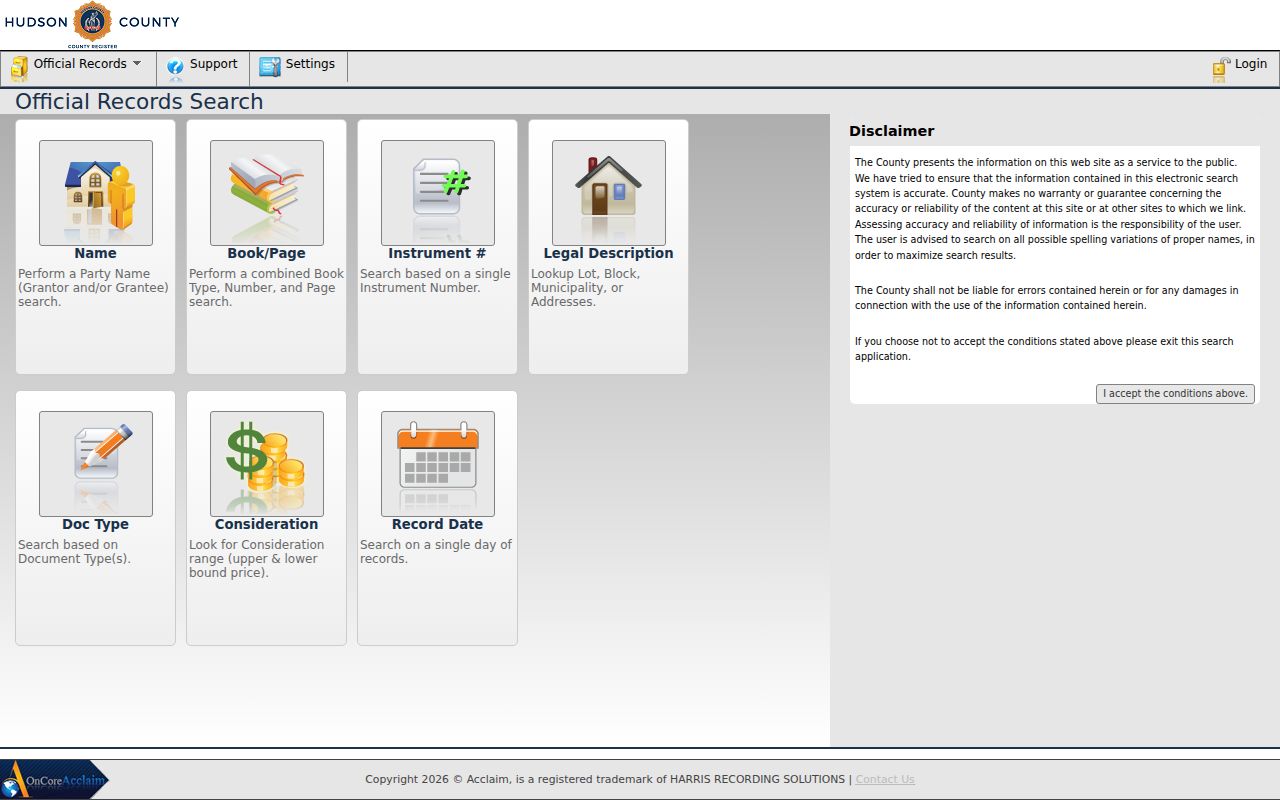
Use the mode that matches the Hoboken detail already known. The captured landing page did not disclose the online start year, image availability, copy fees, or archival cutoff, so older Hoboken coverage needs confirmation with the Register.
| AcclaimWeb field | How it is described |
|---|---|
| Name | Party-name search for a grantor and/or grantee; test surname and given-name variants. |
| Book/Page | Book type, number, and page. |
| Instrument | One instrument identifier. |
| Legal Description | Lot, block, municipality, or addresses. |
| Doc Type | Portal document-type choices; the landing page did not expose the complete option list. |
| Consideration | Upper and lower price range. |
| Record Date | A single-day record-date search. |
Hoboken Street Records by Address
Hoboken address-keyed records answer different questions, so the useful unit of a Hoboken street directory is the source-and-date pair. Start with the Hoboken property reference, then choose the next record based on whether the question concerns title, a historic listing, a building, a municipal action, or election administration. A street-wide Hoboken answer is usually assembled parcel by parcel or instrument by instrument.
| Address key | Hoboken source path | Useful result | Important limit |
|---|---|---|---|
| Current address | NJ GIS, NJACTB, and assessor | Parcel, block/lot or PIN, tax and owner context | Not a current occupancy list |
| Legal description or recorded address | Hudson Register AcclaimWeb | Instrument, party, date, book/page, and type | Online coverage is not disclosed |
| Historic address | DigiFind-It and HPL | Listing, occupation, address, year, and page | OCR, abbreviations, and missing years |
| Building or block | Sanborn map and historic survey | Footprint, use, adjacent numbers, and survey volume | Historical context, not current ownership |
| Municipal transaction | SDL, Construction, Zoning, and OPRA | Permit, applicant or agent, status, and decision | Public fields and exemptions vary |
| Election district | City Clerk and county election offices | Ward, district, and polling-place context | Not occupancy proof |
The block and lot can hold the property layer together when a street name shifts in form. A directory page and its adjacent entries provide a separate historical layer. Keep them separate in notes, then state exactly which layer supports each conclusion.
Hoboken Owners, Grantees, and Occupants
Myth: a property owner, a deed grantee, a mailing contact, and an occupant are the same person. Hoboken property sources do not support that shortcut. The assessor tracks owner and mailing-address information in its tax-list work. A grantee is the party receiving an interest in a recorded instrument. A deed recording date is not necessarily the date of the underlying transaction. A directory can instead show a person associated with an address in a particular year.
New Jersey’s annual assessor data is filed in January, and a transfer after that filing may not appear in the displayed data until a later update. Daniel’s Law can also mask a protected owner name in parcel or tax-list applications. A missing name is not proof that no record exists and is never a reason to try to reconstruct a protected address.
Hoboken Street Directory History Checks
The historical address layer is strongest when a digitized directory is paired with the source page. DigiFind-It’s city-directory catalog includes visible runs from 1861–62 through 1925–26, with parts and gaps, while HPL holds directory material for 1902–07 and 1909–11. Search a street as well as a surname because OCR can split a name or misread a number. Capture the year, part or page, printed address, occupation, and nearby entries.
The 1861–62 sample includes an entry with a work address and an “h” address. The inspected source did not supply a definitive abbreviation key, so preserve the printed notation and ask library staff about the volume rather than treating one mark as a universal rule. A historic listing is evidence for that edition, not proof about who is present now.
Hoboken Street Maps and Surveys
Hoboken Public Library’s History Collection provides the local map and microfilm fallback. Its Sanborn coverage for Hoboken runs from 1906 to 1938 and can show building footprints, uses, and neighboring numbers. The 2019 Historic District survey adds address-specific building context: its volumes divide streets such as numbered streets, Adams, Bloomfield, Grand, Washington, and Willow Avenue/Court among their reports.
Use the map layer to test whether a building footprint or number makes a claimed address plausible. The 1979 New Jersey Historic Sites Inventory adds another historical source. Neither map source identifies a modern household, so pair a map observation with the dated directory or deed record that answers the people question.
Hoboken Street Files Beyond Property
A permit, zoning, or service record can be useful when the question is about a building action rather than a person. The Hoboken SDL portal describes property-information and permit-status functions, but account and application workflows apply and the public field set was not captured. Construction and Zoning are the city paths for the underlying application, verification, and decision records. An applicant, architect, contractor, owner, or responsible agent is connected to that transaction, not automatically to residence.
When a needed municipal file is not online, the City Clerk routes records requests under the New Jersey Open Public Records Act. Ask for a defined permit, date range, address, or decision instead of a generalized person search. The city form accepts written requests and allows delivery choices, while redactions and costs can apply.
Hoboken Street Election Geography
New Jersey’s Am I Registered? path is an individual status tool, not a browsable Hoboken street directory. The live lookup was access-restricted during inspection, so its current field order and result labels were not captured. Exact county spelling, a hyphen, a former name, or a middle initial can affect a match in election services.
Hoboken has six wards and several voting districts. The City Clerk and county election contacts can route an authorized statutory list question, but ward and district indicate election administration geography, not a neighborhood or a current occupant roster. Signatures, Social Security numbers, and MVC identification numbers are not public voter-list fields.
Hoboken Street Numbers Need Caution
No official source located a citywide Hoboken renumbering year. Treat an old number that fails a current search as an unresolved research question, not evidence that the address disappeared. Compare a Sanborn sheet, directory page, deed legal description, historic-survey report, and municipal map. Retain the original number beside the normalized version so another researcher can test the link later.
The 1804 plan and later growth matter because early streets did not extend as far north as later Hoboken. A record can be accurate for its own period even when it does not fit a present-day map without context.
Where a Hoboken Street Search Stops
A Hoboken street directory search cannot certify who is at an address today. Parcel data establishes property context, deeds establish recorded transactions, and old directories establish a dated listing. Protected records may be redacted through OPRA, the Address Confidentiality Program, Daniel’s Law, court rules, or a record-specific law. The Register’s online cutoff and image access were not disclosed; NJACTB’s live search fields were blocked by CAPTCHA; and no official reverse-directory run was verified.
Use the documented fallbacks: the Register search room or Register contact for older deed coverage, the assessor or City Clerk for tax-list questions, HPL Special Collections by appointment for local directories and maps, and the State Archives for older Hudson County chancery and estate-index material. A written, signed, and dated OPRA request must go to the correct custodian. A phone call alone does not trigger the statutory request process.
Lawful use. Use Hoboken address records for personal, historical, estate, or civic research. Do not use a record to stalk, harass, threaten, impersonate, expose a protected person, or confront someone.