
Hoboken City Directory Collections at a Glance
The documented shelf has two complementary access paths. Digitized material reaches far back into the nineteenth century, while Hoboken Public Library keeps a shorter directory run on microfilm or online. Neither list proves that every annual issue survives or is searchable, so record the specific volume and image used.
| Collection | Years | Where Held | Access |
|---|---|---|---|
| DigiFind-It city-directory catalog | Visible runs from 1861-62 through 1925-26, with parts and gaps | Hoboken DigiFind-It | Digitized catalog and page images |
| Gopsill directory material | 1886-87 | DigiFind-It catalog | Confirm the relevant item in the viewer |
| HPL directory shelf | 1902-07 and 1909-11 | Hoboken Public Library History Collection | Microfilm or online access |
| Later DigiFind-It collection | 1971-80 collection | DigiFind-It homepage | Confirm item years and page counts in the viewer |
The Hoboken DigiFind-It city-directory view displays 292 catalog items, but that total is a catalog count, not an uninterrupted run of annual directories. Visible items include early yearly titles, later Gopsill material, several early twentieth-century parts, and later scattered years.
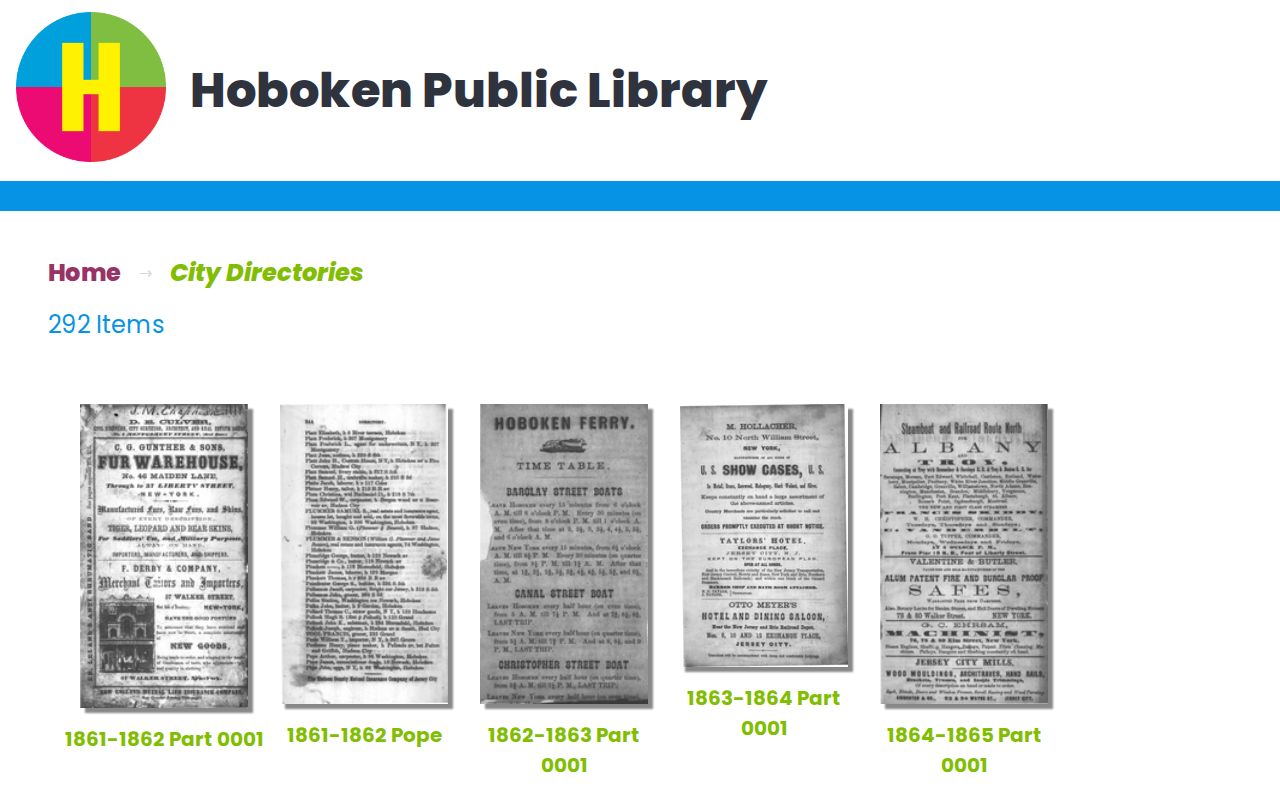
The catalog image is a useful starting point for selecting a likely year. Once inside an item, search the surname and the street separately, then inspect the page around any OCR hit because names and numbers can be split or misread.
Read a Hoboken City Directory Entry
The inspected 1861-62 page is best treated as a compact historical transcription rather than a modern profile. It can place a person in an address context, but it does not independently establish title, a complete household, or a current connection to that address.
| Name | The printed surname and given name identify the entry, preserving capitalization and spelling from the page. |
|---|---|
| Occupation | Entries may include a trade or professional description, such as baker, engineer, apothecary, or gas and steam fitter. |
| Address information | An entry may show a work or business address, a second address, and a Hoboken place marker. |
| Household clue | The sample uses widow notation, including “wid of Charles,” which is a clue to investigate with other dated sources. |
| Printed home marker | The sample prints “h 93 Wayne” after “45 Montgomery”; the source supports a cautious home or house context, not an unverified universal rule. |
For example, the 1861-62 source prints “HETHERINGTON SAMUEL, gas and steam fitter, 45 Montgomery, h 93 Wayne.” It also prints Hexamer Philip at 155 Washington, Heyder Charles F. at 181 Washington, and Higgins Harriet as “wid of Charles” at 190 Washington. Transcribe a page-year citation with the wording instead of silently converting the addresses into modern form.
- Criss-cross directory
- A directory arranged by street or address rather than by name. No official Hoboken reverse or criss-cross run was verified in the research, so it should not be assumed to exist in a particular volume.
- Householder index
- An index intended to lead from a household or address clue to a name. No separately verified Hoboken householder index was located among the documented local runs.
- Abbreviation key
- A guide within a volume explaining printed shorthand. A definitive Hoboken key for h, r, wid, and related marks was not located in the inspected sources; ask HPL staff or use surrounding entries before expanding a mark.
Trace Hoboken Directory Households
A directory sequence becomes more reliable when each step is paired with another dated record. HPL’s listed census microfilm includes federal New Jersey schedules for 1850, 1860, 1870, 1880, 1900, 1910, and 1920, along with New Jersey state census runs for 1885, 1895, and 1905. The usual federal 1890 census loss is a source gap, not proof that a person disappeared.
- Locate the surname in the closest available directory and capture the year, part or page, occupation, address wording, household notation, and adjacent entries.
- Search the same surname and street in the next usable directory item, recording changes rather than assuming a gap is a move.
- Pair the directory year with the nearest HPL federal or New Jersey state census, comparing names, ages, relationships, and address clues.
- Test continuity with a tax list, deed index, newspaper notice, vital-record index, or Museum record that is dated to the question.
- Write down unresolved alternatives such as OCR error, name variation, renumbering, or boarding instead of converting uncertainty into a conclusion.
The federal 1890 schedule is not available through the standard census loss. A missing 1890 entry therefore carries no conclusion by itself; continue with the closest directory, state census, newspaper, or tax-list evidence.
For an event clue, the research also identifies FamilySearch collections for New Jersey marriages from 1678-1985, births from 1670-1980, county marriages from 1682-1956, and wills and deeds from around the 1700s through 2017. Their indexed fields, images, and privacy limits vary, so save the collection name and citation with any match rather than treating an index result as a complete file.
Hoboken Directory Address Myth
A printed address is evidence that a directory connected the named person with that location in that edition. It is not proof that the person owned the building, lived there continuously, or had only one address. The Hetherington example contains both 45 Montgomery and h 93 Wayne, and the library’s local history material explains why directories can combine work, residence, lodging, household, and civic clues in one book.
Keep the original street number, avenue abbreviation, and Hoboken suffix in a transcription field. If a present-day comparison is useful, place it in a separate note. Hoboken’s grid developed over time, and early nineteenth-century streets did not extend as far north as the later city, which makes a period map important before equating historic and current addresses.
Hoboken Directory Catalog Gaps
DigiFind-It visibly lists 1861-62 through 1871-72 in its early sequence, then later material including 1886-87 Gopsill, 1902-03 parts, 1904-05, 1906-07, 1909-11, 1918, 1922-23, and 1925-26. That pattern is valuable evidence of what can be tried first, but it is not evidence of continuous annual publication or complete digitization.
The homepage also exposes a 1971-80 city-directory collection. Its existence is a lead, not a promise about individual years or page counts. Open the collection, identify the item and its title page, and record the actual year before using it in a household sequence. An absence can reflect an unscanned volume, an OCR problem, a move, a name variation, a street-number change, or a boarding arrangement.
Hoboken Library Digital Viewer
Hoboken Public Library’s History Collection is the practical local fallback when a digital search is thin. Special Collections are open by appointment during building improvements, and the library states that there is no charge. Contact the desk at (201) 420-2346 ext. 5101 or reference@hoboken.bccls.org; James Cox is identified as Special Collections Manager.
HPL lists city directories for 1902-07 and 1909-11 on microfilm or online. Use that shelf to corroborate a digital hit or to inspect a run where OCR does not find a spelling. The wider collection also includes books, manuscripts, maps, oral histories, photographs, scrapbooks, and vertical files. Its early twentieth-century tax-list material, 1913 municipal yearbook, cemetery-trustee records, fraternal material, and Hobokenites binders can supply context but are not complete citywide lists.
HPL reports more than 600 Hoboken-history books, original council minutes from the early 1900s, more than 1,000 historical photographs, and oral histories with Hoboken residents. The 2022 American Rescue project recorded 16 oral histories focused on COVID impacts. These are sources for community history and context, not evidence that an interview subject remains at a particular address.
Hoboken Directory Year Sources
HPL’s newspaper holdings can narrow a date or explain a name variation. Listed runs include the Hudson County Democrat for 1856-67 and 1883-89, Hoboken Advertiser for 1878-83, Observer or Hudson Observer for 1904-24, Hoboken Reporter for 1983-92 and digitally for 1995-2017, and Jersey Journal for 1867-2018. Heritage Hub provides searchable obituaries and death notices, while full-text newspaper results depend on the fields and indexing available.
For an address question, HPL’s Hoboken Sanborn maps cover 1906-1938 on microfilm or online. They can show a building footprint, numbering context, and adjoining addresses, but they do not identify an occupant by themselves. Use a map after, not instead of, the directory or census evidence.
Hoboken Museum Collections Add Local Context
Hoboken Historical Museum is the companion catalog for a directory lead. Its people file contains more than 17,000 names and the current Online Collections display totals 20,328 entries across overlapping categories. Those category totals are catalog groupings, not a population count. Archives, Library, Objects, Photographs, named personal collections, and real-estate material can point to a storefront image, map, or document that puts a printed line in context.
The current display lists 5,193 Archives entries, 888 Library entries, 7,099 Objects, 7,122 Photographs, and smaller named collections. An older museum collection page describes nearly 16,000 records and 56,000 viewable images, which is why the date and version of any catalog total should be noted. The museum collected material from 1986 and formally accessioned and cataloged it from 2001.
For a focused collection question, use collections@hobokenmuseum.org or call (201) 656-2240. A catalog hit may not have a digitized image or unrestricted file, so ask about appointment, permission, reproduction, and privacy conditions before relying on it.
Hoboken City Directory Timeline
- 1861-62: the inspected directory sample provides name, trade, address, widow, and printed home-marker examples.
- 1862-63: another sample identifies the City Clerk’s Office at Odd Fellows Hall and City Hall at 35 and 37 Newark av.
- 1886-87: Gopsill material is visible in the digitized catalog.
- 1902-11: HPL lists the 1902-07 and 1909-11 directory runs on microfilm or online, while DigiFind-It also shows relevant early twentieth-century items.
- 1918 to 1925-26: the visible catalog continues with selected later entries, followed by a separately exposed 1971-80 collection that needs item-level confirmation.
This timeline marks documented access points, not a complete publication history. Retaining that distinction makes a Hoboken city directory trail more useful to future researchers and avoids turning a catalog display into a claim that the source does not support.