
Finding Hoboken Resident Records
Hoboken has no single official roll of everyone who lives in the city. Start with the question. A parcel question belongs with the assessor, the state parcel service, and the Hudson County Register. A historical household is often better found in a directory, census film, or newspaper. A court question begins with the statewide case jacket, while a modern birth, marriage, or death request has eligibility rules. Each source records a different relationship to Hoboken, not a universal identity.
Use a name variant and the full address when possible. Keep the record date beside every result. That small habit separates a person who owned a parcel, signed a deed, appeared in a directory, or served in a city role from a person shown at a current address.
- Normalize the name, former name, initials, and street address before searching.
- Check the property and parcel path for block, lot, owner, mailing, and assessment context.
- Test a recorded-instrument trail through AcclaimWeb using party names or a legal description.
- For a past household, search Hoboken directories by surname and by street, then save the year and page.
- Use a focused Open Public Records Act request, library appointment, or clerk request when an online index does not hold the needed file.
Hoboken Resident Record Custodians
City Hall routes municipal records, but Hudson County and New Jersey also keep vital parts of the Hoboken trail. The City Clerk manages municipal records and OPRA routing. The Register maintains recorded land instruments. The Tax Assessor maintains the tax map and tax list. County elections contacts handle statutory voter-list questions, and the state provides the individual voter-status route. For an address-by-address route through these sources, use the Hoboken by-street record path.
Hudson County Register
Hudson County Plaza, 257 Cornelison Ave., 2nd Floor
Jersey City, NJ 07302
(201) 395-4760
Hoboken Tax Assessor
94 Washington St.
Hoboken, NJ 07030
(201) 420-2000 ext. 1230
Hudson County Elections
Hudson County Plaza, 257 Cornelison Ave., 4th Floor
Jersey City, NJ 07302
(201) 369-7740
Hoboken Deed Names in AcclaimWeb
The Hudson County Register’s AcclaimWeb is the primary online lead for deeds, mortgages, liens, releases, plats, and other recorded instruments. Its landing page offers Official Records, Name, Book/Page, Instrument Number, Legal Description, Document Type, Consideration, and Record Date routes. A party-name query may be run as grantor or grantee. Legal-description searching can use lot, block, municipality, or address information.
| AcclaimWeb field | Use in a Hoboken search |
|---|---|
| Name | Test grantor and grantee spellings separately. |
| Book/Page or Instrument Number | Reconnect a known recorded document. |
| Legal Description | Use lot, block, municipality, or address variants. |
| Document Type, Consideration, Record Date | Narrow an instrument trail without assuming a result proves occupancy. |
The public landing page did not disclose the online start year, image availability, or copy charges. Try alternate spellings, then confirm older coverage and copies with the Register rather than filling a gap with an assumption.
Hoboken Property Names Need Context
The Hoboken Tax Assessor maintains the tax map and tax list, including owners, mailing addresses, and assessments. NJACTB is the official county-tax-board entry point for owner and deed inquiries, although its live form was CAPTCHA-blocked during research. The state parcel path documents address, county, municipality, block, and lot dimensions. It is useful for identifying a parcel and its geography, not for certifying a boundary or naming an occupant.
Owner, grantee, mailing address, and occupant are different labels. State property data is filed annually in January, so a later transfer may not appear in that year’s display. Daniel’s Law can also mask protected names in hosted parcel and tax applications. A missing name can be a lawful protection, not a failed search.
- Parcel
- A defined property unit represented by mapping and tax data.
- Block and lot
- Identifiers used to locate property within municipal tax records.
- Index
- A finding tool that points to a record; it is not always the record image.
- Roll
- A maintained list for one administrative purpose, such as tax or voter administration.
Hoboken Courts Match Names Carefully
For a one-person search, the New Jersey eCourts Civil Case Jacket offers docket, party-name, and judgment routes after case-type selection and CAPTCHA. Individual searching requires last and first names, with middle initial optional. Very short first and last terms behave as exact matches, while at least three characters in one name broadens the search. A result displays name, venue, docket number, caption, and case initiation date.
A docket result is a lead, not an identity conclusion. Check the venue, caption, and date before treating a name as a match. Depending on case type, an online jacket may show proceedings or document lists without the actual filed text. Municipal matters route through NJMCDirect, and older, sealed, expunged, juvenile, adoption, or confidential matters have separate access limits and clerk-request paths.
Hoboken Voter Status Boundaries
New Jersey’s Am I Registered? route is an individual status tool, not a free resident directory. The live form was access-restricted during research, so its exact field order should not be inferred. County spelling, spaces, hyphens, former names, and middle initials can matter in election services. Hoboken’s six wards and voting districts provide election geography, but a ward does not establish a household or neighborhood relationship.
State law permits certain voter-list access through the statutory request process, with a reproduction charge that can reach $375. Signatures, Social Security numbers, and MVC identification numbers are excluded. Use the County Clerk or election officials for an authorized list question, and avoid treating a registration form or old directory as proof of current status.
Note: A status lookup and a statutory voter list serve different purposes, so their availability and fields should never be described as the same.
Current Hoboken Resident Source Routes
Current Hoboken sources are most useful when the reader first decides what needs to be tested. A property source connects an owner or mailing record to a parcel. A Register index connects parties to recorded instruments. The city office directory verifies an official role, not general residency. The voter route confirms an authorized individual status. Court, vital, and custody sources have their own rules and cannot be combined into one result.
| Hoboken source | What it can show | Custodian | Access route |
|---|---|---|---|
| Tax map and tax list | Owner, mailing, assessment, and parcel context | Hoboken Tax Assessor | Office, city route, NJACTB link |
| AcclaimWeb | Parties to recorded instruments | Hudson County Register | Online index and counter |
| Voter status | Authorized individual registration status | New Jersey elections | Official status portal |
| City office directory | Current city office and staff contacts | Hoboken | Municipal directory |
| Case jacket | Public case metadata where available | New Jersey Judiciary | eCourts and clerk request |
A name that needs cross-checking across these sources is better handled by the focused Hoboken resident lookup method than by broadening a single result.
Hoboken OPRA Record Requests
When a municipal record is not exposed online, the City Clerk is the documented Hoboken routing point. City records may be requested through the clerk with a written request, by fax, or by email to the city’s OPRA address. The state says a request must be complete, signed, dated, and directed to the correct custodian. A phone call or fax alone does not trigger OPRA deadlines. Request a defined record, date range, and format instead of asking for every item about a person.
The Hoboken OPRA form gives delivery choices for pickup, mail, inspection, fax, and email. It lists letter-page copies at $0.05 and legal-page copies at $0.07, while special formats, postage, and service can carry actual costs. County records use the county’s own request route.
Hoboken City Clerk information shows the municipal record-routing context.
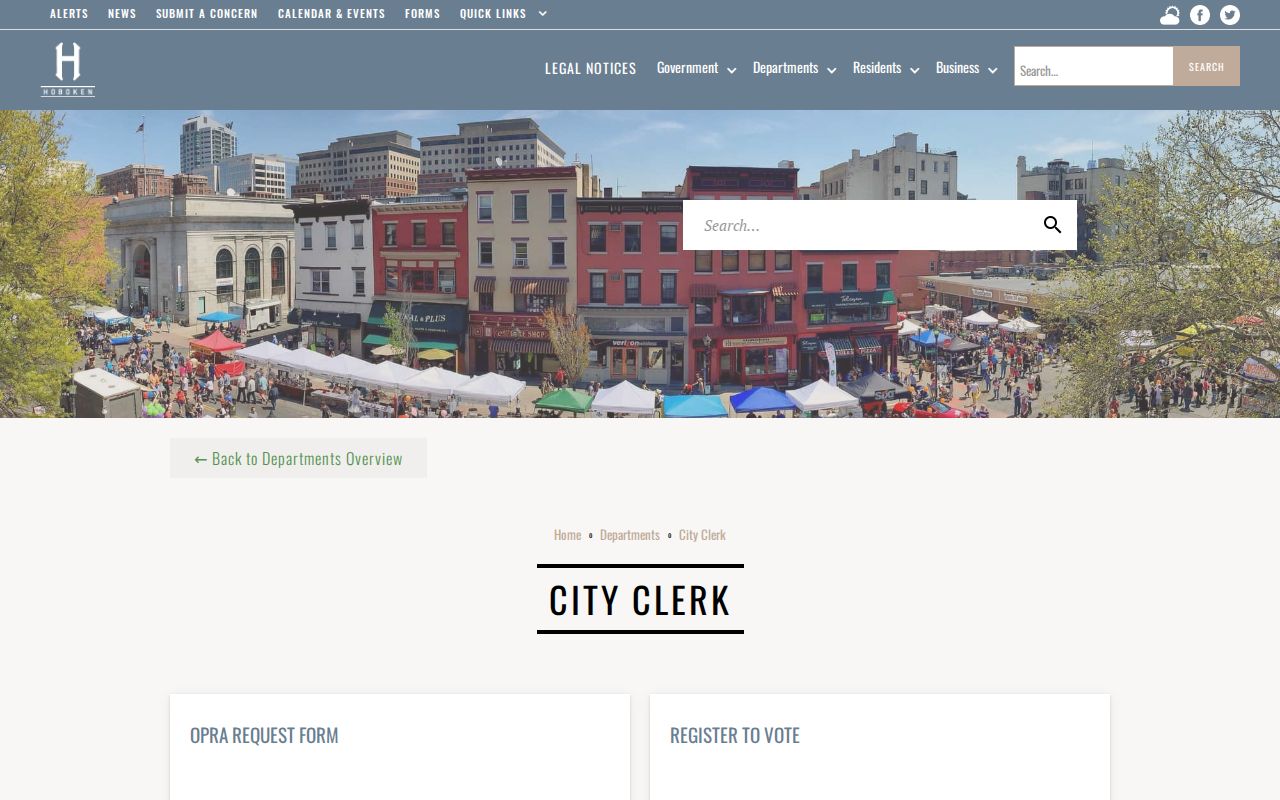
The City Clerk is a route to a defined municipal record, not a searchable citywide resident list.
Hoboken Vital Record Access
Modern vital records are applications, not open name-search results. Hoboken Vital Statistics can route local applications, while the New Jersey Department of Health issues state copies and the State Archives holds older series. New Jersey restricts non-genealogical births for the most recent 80 years, marriages for 50 years, and deaths for 40 years. Eligibility, identification, relationship, and event details control the type of copy available.
The state describes a $25 initial search that includes one certified copy, certification, or No Record response, with $2 for an additional copy of the same record. A certified copy is different from a plain-paper certification. For historical family work, use the Archives and genealogy channels rather than assuming a modern certificate will be publicly searchable.
Hoboken Library History Sources
Hoboken Public Library is the local shelf for directories, census film, newspapers, maps, and oral histories. Special Collections are open by appointment during building improvements, with no charge stated. The library lists federal New Jersey census microfilm for 1850, 1860, 1870, 1880, 1900, 1910, and 1920, plus state census years 1885, 1895, and 1905. The missing 1890 federal census is a records loss, not evidence of an absent household.
Library newspaper resources and Heritage Hub can supply dated obituary or family leads. Sanborn maps can show a building footprint or adjoining numbers. The Hoboken Historical Museum adds a people file, photographs, objects, maps, and contextual collections. These sources are strongest when used beside a page image or official record, not as a substitute for one.
Hoboken Privacy Limits Matter
New Jersey OPRA starts with access to government records, but custodians can redact protected information. Home addresses and telephone numbers may be withheld when privacy outweighs the public interest. The Address Confidentiality Program provides a substitute address for eligible survivors and protected health participants. Daniel’s Law permits masking for covered public officials and their immediate households across city, county, and state systems.
Do not try to reconstruct a protected address from other sources. A city address, parcel, voter record, docket, and directory can each have different access rules. The narrowest applicable rule controls the record request.
Hoboken ZIP Record Geography
Hoboken’s documented USPS ZIP is 07030, but a ZIP is a delivery geography, not a resident roll or city boundary. The Hoboken Main Office record is a postal reference point, while property records use block and lot and elections use wards and districts. USPS notes that ZIP and address updates can take 30 to 60 days. Historic directories usually print a street and place name, not a modern ZIP.
Nearby postal labels changed in 2017 for several Union City ZIPs previously labeled HOBOKEN 07030. That was a mailing-label change, not a municipal-boundary change. Normalize an individual address through USPS, then use the street and parcel path for a location question.
Hoboken Grid Record Clues
Hoboken’s address records reflect the city’s physical history. John Stevens acquired the land in 1784, and the Hoboken Land & Improvement Company laid out the city grid after its 1838 creation. Hoboken became a township in 1849 and a city in 1855. Numbered east-west streets and Washington Street’s north-south role are useful research anchors, but early streets did not extend as far north as later ones.
That history is why an old directory, deed, map, and current parcel may use different forms of the same place. Preserve the printed address, including an abbreviation such as “Newark av,” then enter a normalized modern address separately. No official citywide renumbering year was found, so a mismatch should be tested against directories, Sanborn sheets, historic survey reports, deeds, and municipal maps instead of assigned a date.
Hoboken Record Sources Compared
Official Hoboken record routes are narrower than a broad commercial search. That narrowness is useful. It tells the reader what a result means and who can verify it. The assessor’s material can describe a parcel and its owner or mailing context. The Register’s index identifies a recorded party and instrument. A directory supplies a year-specific printed listing. A commercial search category may combine records from different dates, but it should be treated only as a lead and checked against the custodian’s source.
| Hoboken evidence | Best use | Limit to keep |
|---|---|---|
| Assessor or parcel record | Connect an address to block, lot, assessment, and owner context. | An owner or mailing field is not proof of occupancy. |
| Register instrument index | Trace parties, document type, and recorded property history. | A deed date and a recording date are not always the same event date. |
| Hoboken directory page | Place a person, address, and sometimes occupation in a named year. | OCR, abbreviation, and address changes require a page-image check. |
| Commercial search category | Generate a question to verify with an official or historical source. | Dates, identity matches, and source coverage may be unclear. |
A difference between results is a reason to look for the record date, role, and custodian. It is not a reason to choose the most convenient result.
Hoboken Archive Research Paths
Older Hoboken questions often leave the current portals behind. The New Jersey State Archives holds births through 1924 and marriages and deaths through 1950, while the Department of Health handles later state series under its access rules. The Archives also documents Hudson County Chancery material and estate and probate indexes for 1840–1948. Those collections can provide a historical lead when a local property or directory search stops, but each item still has its own index, microfilm, image, or original-record conditions.
Hoboken Public Library, the Historical Museum, and the State Archives work best as a sequence rather than substitutes. Use the library for local directories, census film, newspapers, maps, and staff-guided history work. Use the museum catalog for people files, photographs, objects, and local context. Use the State Archives for older statewide and county series. Save the collection name, year, page or reel, and access date with every Hoboken finding so another source can confirm it.
Historic Hoboken Directory Sources
Hoboken DigiFind-It presents 292 catalog items and visible directory runs beginning in 1861–62, with later parts and gaps through 1925–26. A separate 1971–80 collection is linked from its homepage. HPL also lists microfilm or online access for 1902–07 and 1909–11. A directory entry may contain an occupation, address, household notation, or business address, but it does not automatically establish ownership or current residence.
The 1861–62 sample illustrates the point: a person can appear with a trade address and a separate printed home marker. Search the surname and street separately, preserve the exact year and page, and compare that entry with census, tax, deed, newspaper, or archive material. The fuller collection path is available through Hoboken City Directories.